CHARON KRANSEN
DE PROFUNDIS
Interview by Loukia Richards & Christoph Ziegler
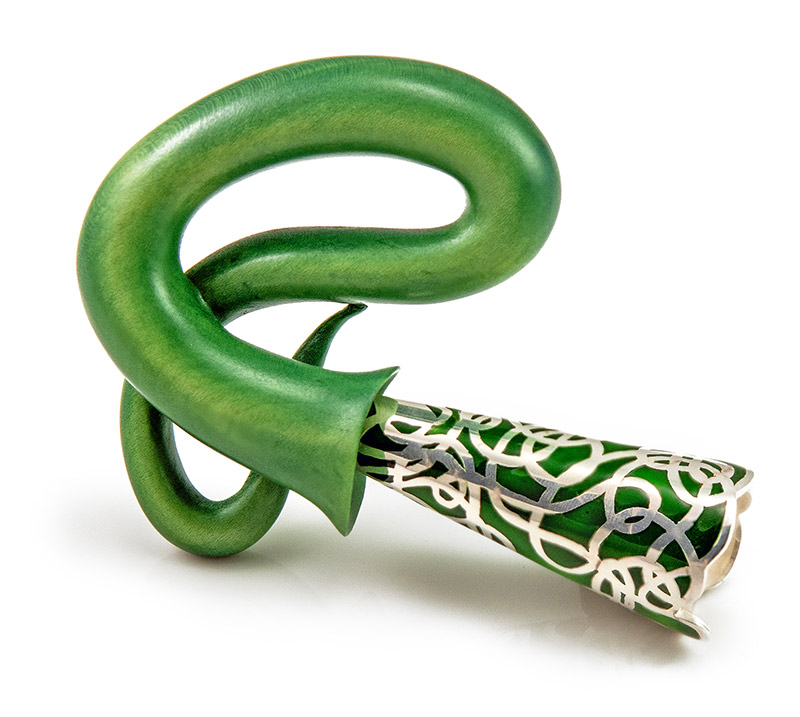 Verdancy – brooch by Daniel DiCaprio, 2025. Silver, carved holly, steel, brass, enamel. Photo: Courtesy of C.K.
The renowned jewelry expert, educator, and dealer Charon Kransen urges artists to reflect on work ethics and vision but also emphasizes the benefits of understanding the rules of the art business.
SMCK: We asked fellow artists how they perceive the gallery’s role and the responses suggest it is hugely misunderstood.
CK: To me there is an overall issue. I've been a maker, I was a professor, now I'm a dealer; I'm curating, I'm lecturing, I'm, you know, blah, blah, blah…I do individual mentoring and so I view the field from a number of different angles – educational, organizational, curatorial. I've traveled all over in the world, and my observations come down to this: “Why is it that so many in the field have similar problems and keep falling into the same kind of problems?”
And the bottom line to me is an issue that a lot of artists have: they're very professional in how they make their work, but they're completely unprofessional in how to deal with it. It's almost like saying, you have a product, and you want to sell that product. So, you need to understand something about business, how that works.
We call it the ‘ABCs’ of business. I'm not a business-minded person, but I had to learn. To me, the main thing – and it's kind of hard to say it publicly; I think I've come to the conclusion at this point, and of course there are lots of exceptions – is that most artists are really desperate.
"Unless you belong to the very top of recognized jewelry artists, you are having a very hard time surviving."
SMCK: Desperate now, at this point, or in general?
CK: In general. Desperate. Desprerados. And what I mean by that is they feel basically under-respected, under-rewarded, under-recognized, under-published -- all of the above.
The kind of jewelry that I'm talking about – whatever you want to call it: art jewelry, or jewelry that is related to content versus elegance, beauty – it's a relatively very small field within the bigger jewelry field. Most of these people, unless you belong to the very top of recognized artists, are having a very hard time surviving, and because all of these things combined, they make decisions that often come from feeling desperate: "Oh, if I don't do this, oh, if I don't say yes, I will not be recognized, and they will not count me in anymore next time, and they will never ask me for an exhibition, and they will never ask me for a publication, so I need to be part of everything. I need to say yes to everything."
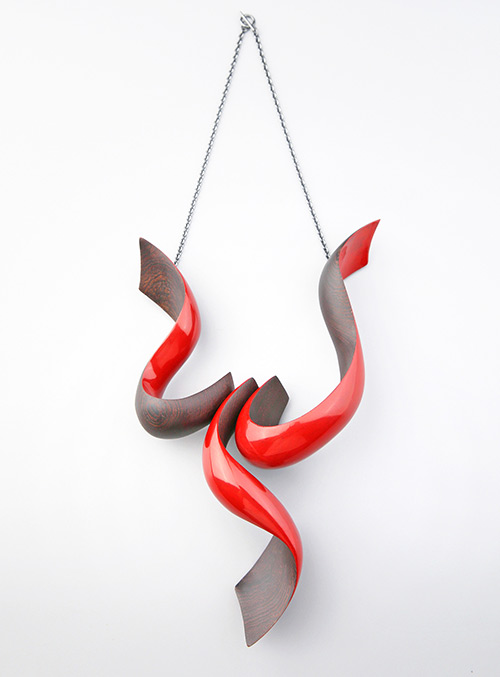
Confluence 24 – necklace by Joo Hyung Park, 2024. Wengee wood, ottchil, silver. Photo: Courtesy of C.K.
SMCK: We completely agree with you.
CK: And we know that once you are desperate, per definition, you don't make the right decisions. You don't take the time to think about it. You don't take the time, period. You don't think of the result of your actions. Like, what are the consequences when I do this? "Oh, I wasn't thinking about it."
Well, you're not thinking about so many things because you're so preoccupied with, you know, your need to become part of it, and every day you need to is exhausting. Take your time. Say 'no' to things. Set boundaries.
SMCK: 'No' makes you who you are. 'No' comes with a price, and you have to work very hard for many years, on many levels, to survive and remain true to your own vision.
CK: Right. I often use this as a sort of metaphor. You're a pretty girl, you walk down the street, and you know, there are some workers, whatever, and they're like, ah, you know...Are you jumping into bed with them immediately because you're just so desperate?
SMCK: Hmm...
CK: What about learning how to say 'no', learning how to set boundaries? The truth is that often these young artists can barely make a living, so they feel forced, they feel pressured. That is something that is so prevalent now – they just want to make a lot of money.
After we graduated, for the first ten years we weren't thinking about making money, we were just trying to make the best work possible, and we had jobs on the side, all my colleagues; really, times have changed.
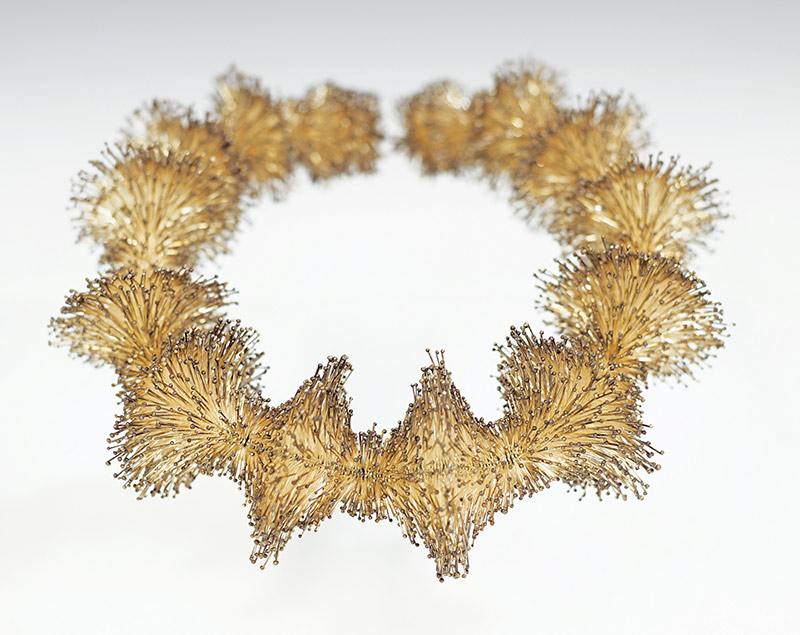 Crystallization of Happiness, Nature interrupted – necklace by Nao Mitzutani. Silver. Photo: Courtesy of C.K.
SMCK: You have Instagram, Facebook, or other digital tools now to reach your audience directly, by yourself.
CK: It's not a problem if you reach potential clients, and you can say, well, I'm working with this or that gallery, I am being represented by so-and-so, you can buy it there. That is, to me, the sort of long relationship with artists who are being represented. But again, because so many artists are desperate, they don't think about it.
So they say: okay, you can buy it from me. Do they understand anything about how you set a price, how you give a discount, how you undercut the gallery, how you maybe feel forced to give the person, even though you don't know the person, a much better price because you're so desperate for money.
And then all of a sudden, the price for that piece is different in the gallery from when you sell it privately. Prices should be more or less the same.
Then somebody will say to me that "I bought this piece from you and then I saw it somewhere else and it was much cheaper" or "I bought it from the artist, and she or he gave me a better price." Maybe, as an artist, you never thought that this would create a problem. You see, there's something wrong and disconnected in the way we understand commitment to a dealer or a gallery or whatever. There's a lot of confusion about that.
SMCK: One can tell the artist that if somebody from your network wants to buy the same piece, at least keep the price that we have set. If that price is 100, it's bad for you to come down to 40 or 50 because what you're doing is discounting your work in general.
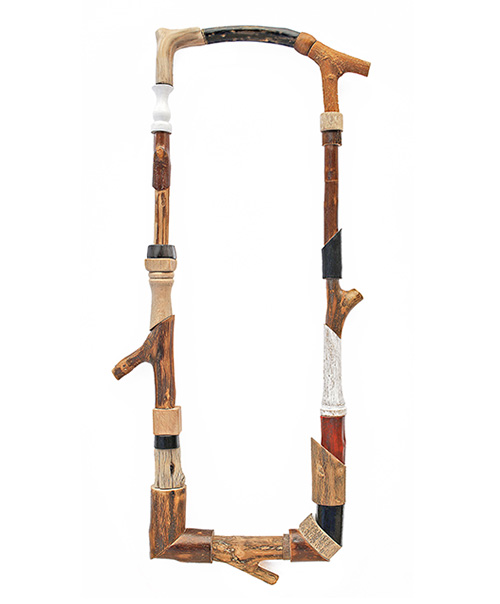
Memories III – necklace by Christoph Ziegler, 2023. Wood, found objects, rubber strings, dye, clear and color coat. Photo: Chr. Ziegler.
CK: Most artists don't understand that. If you want to sell it privately, you sell it for the retail price, for the selling price. Or, you can say "I'm very honored that you are interested in my work, but all the sales go through the gallery." It would make life so much easier.
SMCK: We face something similar in our work We organize curated shows and hardly ever hear "thank you, you did a great job." Show participants rarely even share the invitation for their show with their network. And this is very strange to us, it shows some kind of pathology. Even if you don't feel grateful, you have social manners. When you go to a restaurant, you say thank you to the waitstaff for serving your meal.
CK: Not when you're desperate.
SMCK: So this is the same thing from a different angle.
CK: This is again something that I feel very strongly about: most artists really have no idea what a gallery or a dealer does.
SMCK: What is the gallery's mission?
CK: "Oh, the gallery; I send them work and they sell it and then pay me." Artists don't see a lot of the work that goes into selling. When I fly to the West Coast for several days with a suitcase full of artwork, that is work and that costs money. And nobody sees it because if I sell something, the artist just receives a check.
When somebody asks me to write a recommendation letter, that's work. When somebody asks me to review their portfolio, that's work. A lecture is work. Everything is work – for instance, to be part of a jury is work.
A young professor from China sends me a whole portfolio. "Can you please write me a 300-word essay about my work." Yeah, I can. But you have to realize it's work.
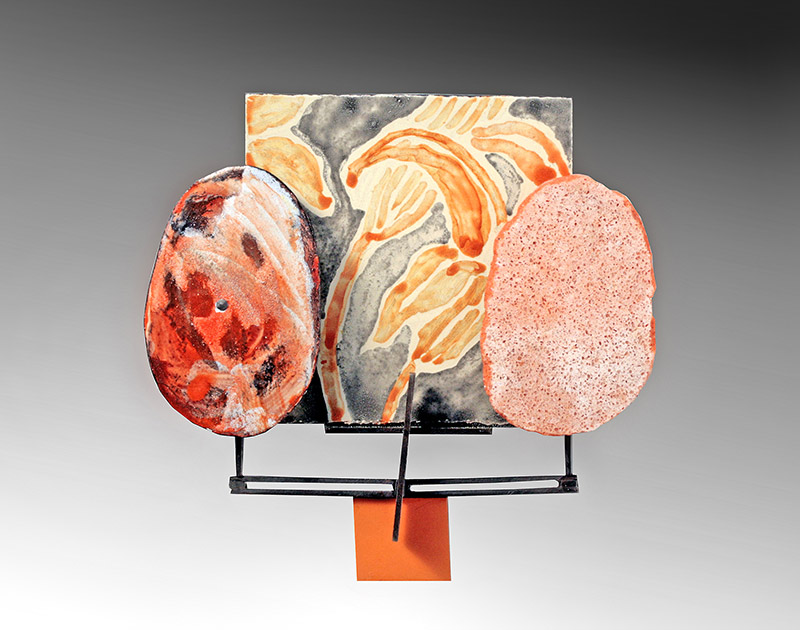 To William Morris – brooch by Ramon Puig Cuyas, 2020. Nickle silver, enamel on steel. Photo: Courtesy of C.K.
SMCK: One should pay for it.
CK: Well, it has something to do with what we talked about before. If artists really understood all these things, they would have more respect. Maybe they would find it easier to make a commitment to a gallery and stay with it. It's like in any kind of relationship. So, again, I'm sort of circling back to this issue – which is a big issue.
SMCK: We have the impression that artists underestimate the art of selling.
CK: There is the art of selling. Artists are not good at selling their work and should leave it to somebody else.
SMCK: Can we outline some rules for a successful cooperation between artist and gallerist?
CK: You have to feel at home with the gallery and the type of collection it is showing.
I'm often approached to represent somebody for the simple reason that my name is known and I'm in New York. And then when I look at the work, I wonder how this person does not see it doesn't fit in the kind of collection that I show. But the artist just wants to be in New York.
I always think ahead. Most artists don't. I have a f*cking opening, people are going to be there. I can't say. "Oh, sorry, my grandmother died" or, "I broke my leg." You sort of go with your instinct, with your gut feeling, and say: "Okay, this is a person with great work, can I work with this person or is there just way too much ego?" If there is, then you're just setting yourself up for huge problems.
"The teachers are not equipped with the knowledge about the real world."
SMCK: What is academia's role in the arts?
CK: In my opinion, in academia it's all about developing your voice by experimenting a lot, by being confused a lot, to find your voice, your language. The rest of the so-called real world comes afterwards. The teachers are not equipped with the knowledge about the real world.
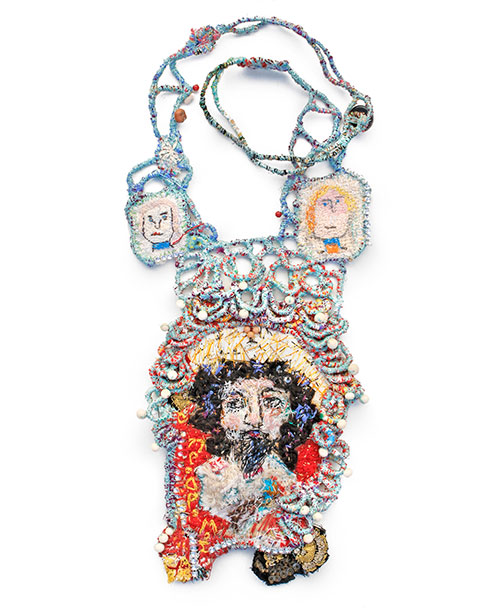
St.John, The Baptist – pectoral ornament by Loukia Richards, 2024. Embroidery on cardboard and textile, silk, cotton, wool yarns, goat hair, sheep wool, antique corals, plastic. Photo: Chr. Ziegler.
SMCK: Yes.
CK: And so we have to learn a lot of things after school. I think one of the most important things for an artist to realize is that your work is your business card. That's why it's so important to focus on creating the best work you can and understanding what it really means when a piece is ready and can leave the studio instead of being stressed by deadlines and special requests and so on.
I end up receiving work that is just not as resolved as it should be and that is difficult because it's my function to advise clients who ask what's new, what's exciting. I don't want to sell a piece that is half-finished That's not good for the client and that's not good for me – and it's not good for the artist either. In that sense, we can sell a piece of jewelry to everyone who has the money; he or she might not even be an art lover.
I'm not that interested in selling something to a buyer. What is much more interesting is how you develop a relationship with this person so that they keep coming back to you because they respect your eye and your vision and come to you for advice.
"The work we make is for a special person."
SMCK: There is a general feeling among artists that the jewelry art sector, at least in Europe, is very shallow. There are no customers, there are not even visitors, and it's becoming obvious at many fairs and weeks. Do you think there is indeed a lack of audience or are artists trying to sell their work in the wrong places?
CK: The work we make is for a special person: it's for a person who has the courage and also the emotional intelligence, the sophistication to look at something and say: "Wow, this is interesting!" even though it's not gold or silver or gemstones or whatever. Interesting, curious. I don't mean this in a sort of pretentious way, but you need a certain sophistication to be able to look at this work and look at your necklace and say "Wow, this is so fascinating, these are all pieces from a life, a history of a life of a person" and be able to feel that and appreciate it for that reason – and maybe put money towards it.
We have to accept that this is, maybe, a kind of elite group. But again, I don't mean that in a pretentious way.
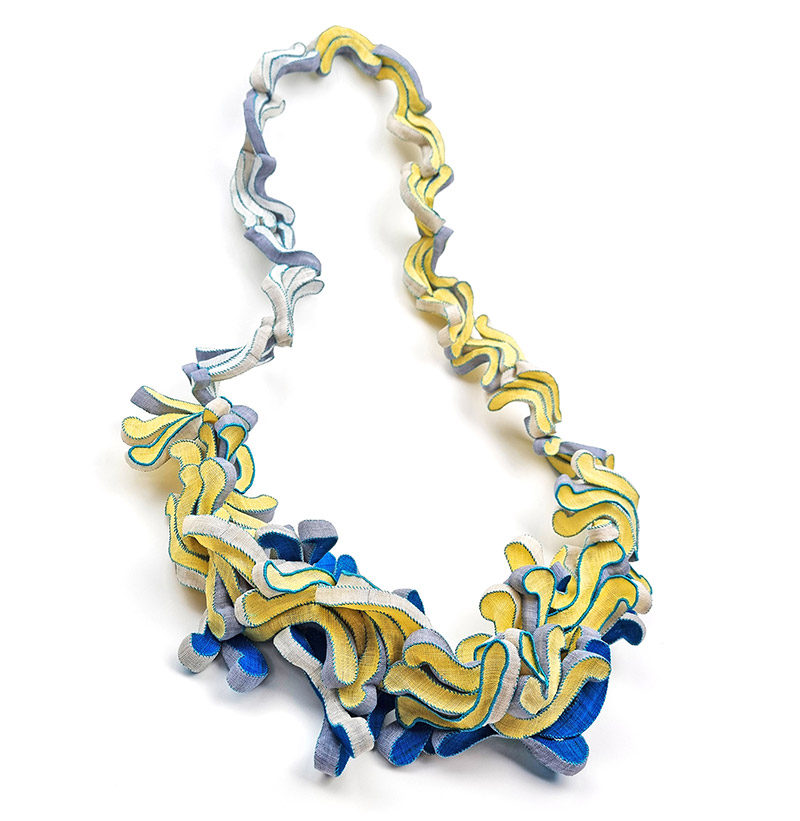
Necklace 6 – Classic Series by Mina Kang, 2024. Ramie fabric, thread. Photo: Courtesy of C.K.
SMCK: Maybe there are people out there who are interested in learning about jewelry.
CK: Well, it's all about education. I became a professor in 1976. For some 50 years, I've been involved in education, in different ways, in different settings, and how I used to educate before is different from what I do now.
The show I'm putting together now is an exhibition to educate people to look, not just glance, but to look at how much time must have been involved in making these pieces. In your case, I think you should maybe just focus on how your work is inspired and let that be the focus, let that be the presentation. Along with your photographs, I've sent pictures to people and they were like "Wow, wow, this makes it so much more dimensional."
"It's not about aesthetics, it's really about vision."
SMCK: Artists we asked said they want to have exposure, exhibitions.
CK: People participate in an event so that they can put it on their CV – for example, 2025, Museum X New York – and give the impression that it was an exhibition, while it was actually a sales event. I read a CV recently, and it said, "Schmuck 2025 Munich," giving the impression that he was selected for the Schmuck exhibition; no, he had a little booth outside.
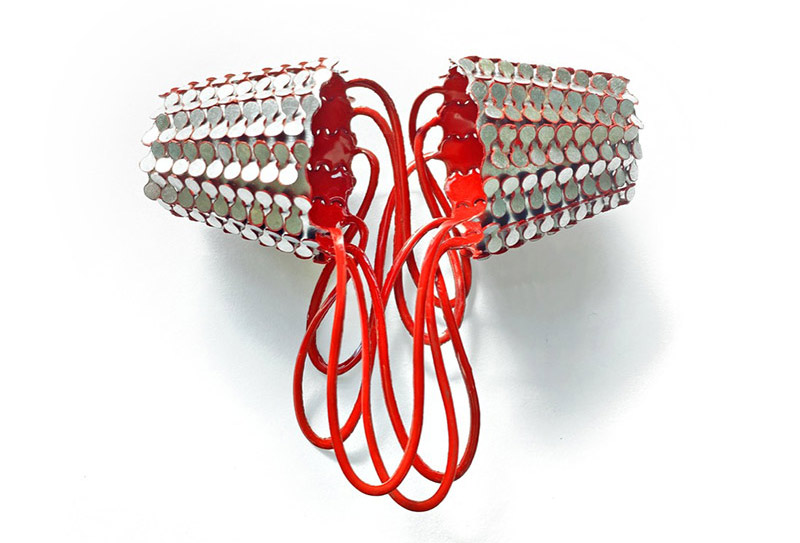 Kanon, The Rythm of Red – brooch by YoungJoo Lee, 2023. Stainless steel, powdercoated. Photo: Courtesy of C.K.
SMCK: Earlier you mentioned seeing exhibitions in Munich last March that were low-level and disappointing.
CK: I've been going to the Munich shows every year for over 35 years and it used to be much smaller and much more intimate. Now everybody wants to be part of the jewelry week, and you see horrible presentations in some horrible looking little spots outside the main fair just so people can put it on their resume. I don't mean to sound snobbish, but I don't want to see all that. If you don't understand that good work also deserves a good presentation, well…and some pieces are just stupid.
SMCK: We curated a group show in a very reputable gallery in Munich some years ago: the exhibition design was nice, the lighting was good, communication was effective – everything was done correctly and the visitors were pleased. The following year, the same artists exhibited in what you would call a hole. How is this possible? Don't exhibit, wait for another good opportunity to show your work in a good context! There is a difference in how work is seen by the audience if it's exhibited in a hole or in a nice gallery. It is common sense.
CK: Yeah, but it's not common sense for a lot of people because they are confused, they don't really have – maybe that's the key word – a vision.
As a gallery, I try to present my vision all these years, consistently. So, it's not about aesthetics, it's really about vision and people understand that; they see the red yarn. Vision is incredibly important.
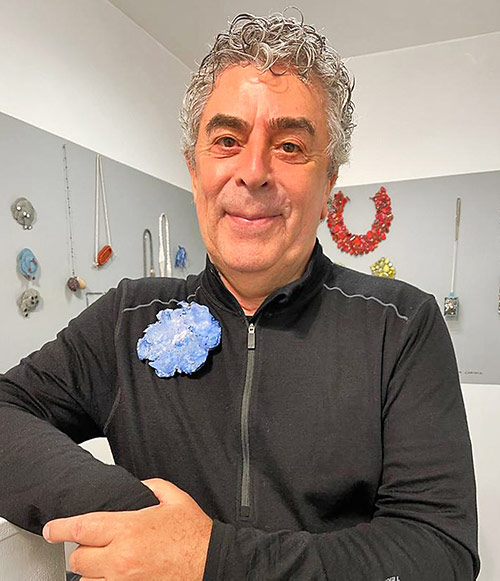
Charon Kransen, portrait photo.
SMCK: How would you describe your vision?
CK: To show work that often is made of non-traditional materials in which the artist, more than anything, infuses the work with the 'je ne sais quoi', their unique personal voice, touch, language. That to me is where each artist is different from somebody else because in most of the work we see, it couldn't be made by anybody else. Although I've seen so much jewelry in my life, everywhere in the world, that is what gets me excited, when I see something I like and my reaction is "Wow, I thought I'd seen everything!" In the work I show, I want people to begin to see that uniqueness in the work and appreciate it for that reason.
LINKS: www.charonkransenarts.com
|
instagram: @charonkransen