

Since time immemorial, art – objects, jewelry, ceramics, textiles – has condensed and manifested the experience of epiphany: a god’s appearance in human life, which turned human beings into bearers of the divine. In archaic thought, a dress, an ornament, a textile motif, a vessel, or a tool was never just a utilitarian object.
In today’s world which is increasingly dominated by technology and AI, and threatened by climate change and destructive wars, the search for meaning has become an existential challenge.
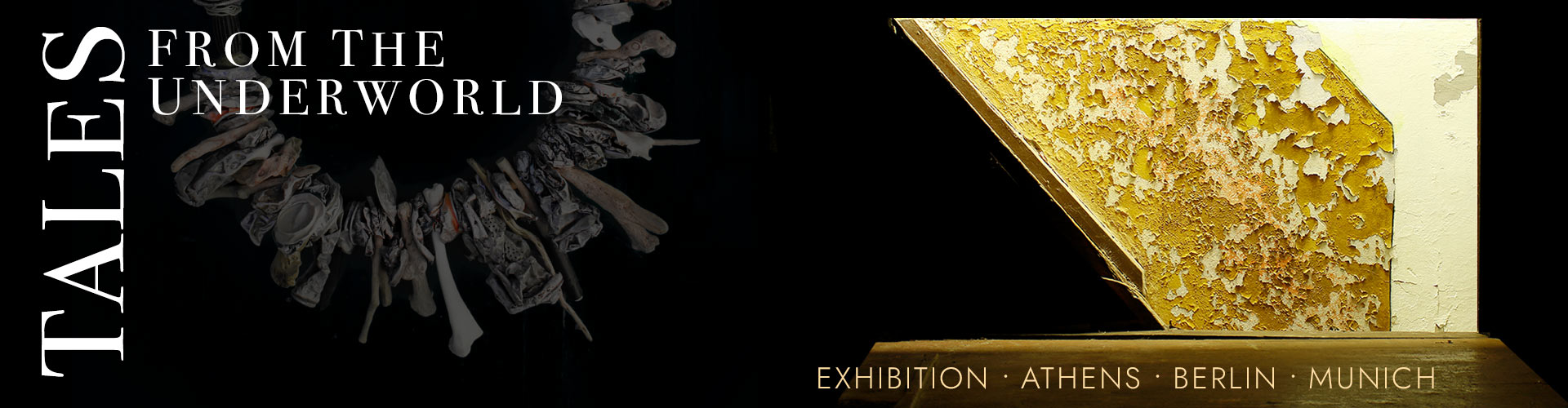
The exhibition project TALES FROM THE UNDERWORLD aims to strengthen the role of jewelry – and objects – in building a bridge between human beings and the eternal cosmic order. It also seeks to extend the physical experience and materiality of jewelry and objects into the realm of ideas.
Drawing inspiration from the Eleusinian Mysteries and the myth of Demeter and Persephone, SMCK Art Space in Athens and OONA Gallery in Berlin are joining forces to co-curate a group exhibition presenting international artists across two countries and three venues. TALES FROM THE UNDERWORLD includes two successive exhibitions in Athens, 6–10 January 2027, and Berlin, 2–11 April 2027, a catalogue presenting the artist’s work, press, PR, and social media promotion, a live event in Athens, and participation in a short documentary by SMCK about the exhibition at Galerie Handwerk in Munich, on 12 March 2027.
"So what?" artists may ask. It is an open secret that the audience for contemporary jewelry is not growing, as potential buyers and enthusiasts often miss its deeper meaning and view it merely as ornament. This joint exhibition gets to the heart of the matter by exploring the ontology of jewelry – its most essential nature – which is to connect human beings with something greater than themselves.
TALES FROM THE UNDERWORLD simultaneously engages in the dialogue between three contemporary European jewelry art metropolises: Berlin, Munich and Athens.
While the Romantic movement named Berlin "Athens on the Spree" and Munich "Athens on the Isar" more than 200 years ago, Athens today is often referred to as the "New Berlin," attracting artists and creative nomads from around the world.The Greek capital also bears the artistic traces of Bavarian rule in the early 19th century.
Reflecting on the history of art and civilization, the history of ideas, and the topography of myth is the starting point for the exhibition TALES FROM THE UNDERWORLD, and a sine qua non for opening up a path to deeper meaning in a jewelry market saturated with commercial events.
The myth of Demeter and Persephone gave birth to the secret rites known as the Eleusinian Mysteries, which became among the most revered religious celebrations of the ancient world from the early history of Bronze Age Greece into Late Antiquity.
Different traditions worldwide – Greek, Mesopotamian, Near Eastern, Egyptian, Aztec, Maya, and Norse – tell of a young god or goddess who dies, descends into the underworld, and comes back to life more glorious than ever before, bearing a new mission. The Christian tradition, viewed as a narrative abstraction, follows a similar pattern.
As a fundamental myth central to ancient Greek religion, a matrix for Christian sacraments, and a reflection on the psychological stages of mourning, the myth of Demeter and Persephone speaks of death and resurrection. It also highlights the mother – daughter relationship – a bond that remains uniquely exclusive in contemporary Greece.
The myth offered solace against the cruelty and injustice of the real world by recalling a time when all human beings were equal and even gods had to suffered. During these rituals of revelation — the Eleusinian Mysteries — absolute equality was established between man and woman, free citizens and enslaved people, rich and poor. Conceived by the collective imagination of the rural community of Eleusis in Bronze Age Greece, the myth also taught how to share the produce of the earth, respect nature, feel compassion for the grieving, honor sacrifice, and praise divine justice.
The Eleusinian Mysteries (mysteries = things that cannot be explained by logic in ancient Greek) also revealed art’s major role in helping humans accept their mortal fate, as contact with the underworld was established through objects, dance, song, and performance. Central to the teaching of transcendence and eternal life were objects designed to visually convey this message to the initiates.
The ancient Greeks placed the entrances to the underworld in various locations. Today, we can still see one of these passages in Elefsina, and another on the hill overlooking SMCK Art Space in Athens.
In our turbulent times, the "underworld" may mean much more than the Greek concept of Hades. It may represent our personal struggle to find meaning and empowerment despite an absurd and violent world. In times of radical political and cultural shifts, the underworld might also signify the only certainty of mortality that feeds our fundamental values that make us feel human and alive. The underworld can mean the reverse of our current reality — a reality that we can actively shape and reclaim.
I. Two Exhibitions: Participation in two curated group shows, at SMCK Art Space in Athens and at OONA Gallery Berlin.
II. Exhibition Catalogue: The participants' works will be featured in SMCK Magazine's issue no. 14 , titled “Tales from the Underworld”, to be published in March 2027, ahead of Schmuck München / Munich Jewelry Week.
III. Press & Promotion: Professional, customized press and social media coverage.
IV. Video screening: Short documentary about the Athens show, to be screened at the 15th Edition of SMCK ON REEL, titled “Tales from the Underworld”, at Galerie Handwerk, during Schmuck München / Munich Jewelry Week 2027.
V. Live Performance: Live Tarot-Moebling Performance with the audience during the exhibition.
Artists working in the fields of contemporary jewelry, (small) sculpture, textiles, objects, crafts, and photography, are invited to apply for TALES FROM THE UNDERWORLD.
Artists can apply for:
Send us one or up to three jewelry pieces or (small) objects that you wish to exhibit.
OR
Send us a photographic composition, collage, photomontage, mixed-media work, self-portrait, etc., featuring one or more objects created by the artist and conveying a personal narrative. The image will be printed and displayed in the two exhibitions. Download the Image specifications (vertical format) >> here.
Paid by the artist.
Jewelry and objects: 380,00 EUR in one or two installments (2x 190 EUR).
Digital photograph: 160,00 EUR in one or two installments (2x 80 EUR).
Send a cover letter, your artist statement, and a weblink, and 1–6 photos of the object/s you propose (Option I), or one photograph or photo collage (Option II), until 22 November 2026.
Include your personal information (name, address, website, instagram and social media links), and send your application via email to magazine@smck.org, or via WeTransfer if the file size is larger than 15 MB.
Applications will be reviewed immediately.
Applicants receive a detailed project agreement.
SMCK Art Space is SMCK Magazine’s Athens art venue. It is located in downtown Athens, in the emerging artists’ neighborhood of Kolonos, near Kapnergostasio, the former Public Tobacco Factory of the Hellenic Parliament, now transformed into a vibrant centre for culture and exhibitions.
OONA gallery is a contemporary jewelry gallery based in Berlin-Mitte. For 25 years, its owner, Anna Schetelich, has been presenting German and international jewelry artists in the heart of the city.
Galerie Handwerk is an institutional gallery run by the Chamber of Crafts for Munich and Upper Bavaria. Every year in March, its exhibition space is dedicated to contemporary jewelry and crafts. Since 2024, SMCK ON REEL has been screened at the gallery as part of Munich Jewelry Week.
Follow SMCK Magazine on Instagram: